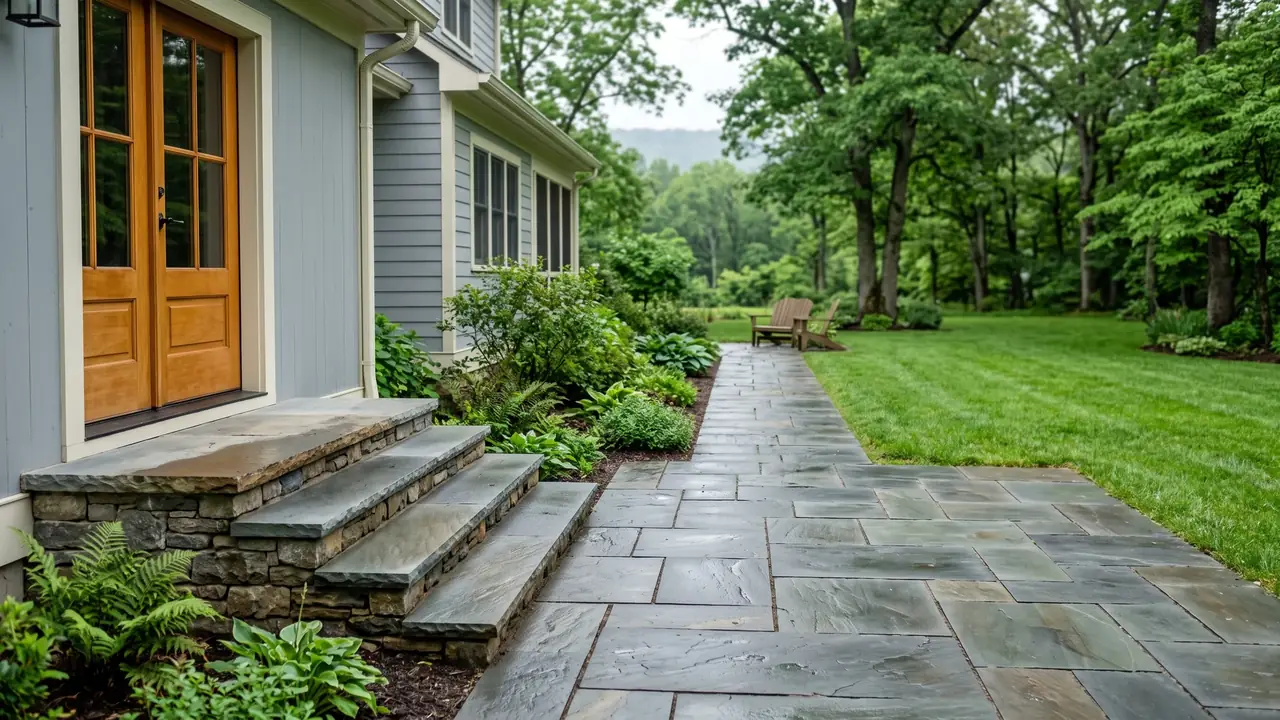
Paver patio installation in Hollins, VA starts at the back door: the landing and steps down to the patio matter as much as the surface. Underneath, a compacted base has to drain through expansive clay and a 24-inch frost depth on the County's design criteria. This site does not install patios. It helps you describe the route and introduces a named local provider with your consent.
A patio in Hollins, Virginia is rarely just a slab of pavers in the lawn. For most homes here it is the surface that connects a back door to the yard, so the layout has to work with the door height, the slope of the lot, and where roof water goes. This page is for homeowners planning a new paver or stone patio, replacing a cracked concrete pad, or extending one that has become too small, and it explains how to describe the project so a reviewer can route it well.
What does paver patio installation in Hollins involve?
Most of the work on a paver patio happens below the finished surface. The area is excavated deep enough for a compacted stone base, the bedding layer and the pavers. In clay-heavy ground the dig often goes deeper than expected.
A geotextile usually separates the base stone from the soil. The base goes in by compacted lifts, pitched so the finished surface sheds water away from the house. Then comes a thin screeded bedding layer, the pavers or stone cut tight at the edges, a rigid edge restraint, and joint sand or a polymeric jointing product, followed by a final compaction.
Natural stone follows the same base logic. Irregular flagstone may be dry-set on a compacted base with wide joints, or mortared to a concrete slab for a tighter look. The two methods differ in thickness, drainage and upkeep. Modular pavers have one advantage over poured concrete: a sunken section can be lifted and relaid instead of replaced as a unit.
Where the patio meets a door or a step, the finished elevation has to be fixed before anything else. The outdoor steps, landings and walkways page covers how that transition is usually handled.
When is a new patio or a replacement the right move?
A new patio makes sense when the yard has no comfortable place to sit or eat outside, when the route from the door drops straight onto grass, or when a later project such as a fire feature needs a level surface to sit on.
Replacement is usually the better answer when a concrete patio has cracked into sections that have shifted, when a paver patio has sunk along the house or at the edges, or when the surface slopes toward the foundation. Relaying a small area of pavers is a fair repair if the base under it is sound. If the base failed because water got under it, relaying the same pavers on the same base tends to repeat the problem.
Extension is a middle path. A sound patio can often be enlarged, though an exact material match is not always possible, and the seam between old and new needs its own base detail.
Why do patios in Hollins settle, heave and hold water?
Three local conditions explain most patio problems in this part of Roanoke County.
First, frost. Roanoke County's published design criteria list a 24-inch frost depth and a "Severe" weathering rating. Water held in or under a patio base freezes and expands in winter, then thaws and lets the surface drop. A base that drains and a surface that sheds water are the main defense.
Second, clay. The County maintains an Expansive Soils Policy because parts of the County have clay soils that swell when wet and shrink when dry; the policy itself notes that this movement cracks walkways and driveways. A patio built on untreated clay moves with it. A thicker, well-compacted base and good drainage limit how much of that movement reaches the surface.
Third, water from the house and the lot. Many lots in the area slope, and the Peters Creek planning area that includes Hollins has a large number of streams and significant floodplain along Tinker Creek, Carvin Creek and Peters Creek. Downspouts that discharge beside a patio keep the base wet for long periods. The patio drainage guide explains what to look for and how a drainage-aware plan changes the design.
What affects the cost of a patio project?
These factors move the scope up or down. No figures are given here; a reliable number only comes from a provider who has seen the site.
- Size and shape. More area means more excavation and material; curves and many cuts take longer than a rectangle.
- Soil and excavation depth. Soft or clay-rich subgrade needs deeper digging and more imported base stone.
- Demolition and disposal. Breaking out and hauling an old concrete pad adds labor and dump fees.
- Material. Concrete pavers, clay pavers, porcelain, cut stone and flagstone each carry different material and labor costs.
- Elevation changes. A patio that must meet a door height, step down to the yard, or be held by a grade wall involves more than a flat installation.
- Drainage work. Rerouting downspouts, adding a drain, or regrading beside the house is separate from the patio itself.
- Access. A narrow side yard, fences or a steep lot slow deliveries and may rule out larger equipment.
- Extras. Borders, inlays, lighting conduit, seat walls and reserved footings for a future feature all add scope.
The cost factors guide covers these drivers in more detail for connected patio, steps and wall projects.
How do you prepare a patio project request?
A patio request is easier to route when it includes:
- Photos. A wide shot from the back door looking out, one from the yard looking back, and close-ups of any cracked, sunken or heaved areas.
- Measurements. Approximate length and width of the area you want, and the height from the door threshold down to the ground or the current patio.
- Water notes. Where downspouts discharge, where water pools after a storm, and whether any part of the yard stays soft for days.
- Use. How many people gather, and whether you want dining, lounge seating, a grill spot, or space held for a fire feature.
- Context. Whether the lot is in or near a floodplain, whether a homeowners association reviews exterior work, and any past repairs.
Larger projects can cross the County's land-disturbance threshold or involve walls that need a permit; the Roanoke County permits page summarizes the published rules, checked October 9, 2026. If a fire pit or fireplace is on the wish list, the fire pits and outdoor fireplaces page explains what to decide before the patio size is final. To see every project type, browse all hardscape services.
Requests are accepted from the Hollins area of Roanoke County, including the neighborhoods around Hollins University, Plantation Road, Peters Creek Road, Hanging Rock and Valleypointe, and up toward Carvins Cove and the Tinker Creek corridor. When a provider fits the job, you get that provider's name and decide whether to be introduced.
Local rules and sources on this page were checked on October 9, 2026. Requirements change; confirm with the responsible office before work begins.
Decide the next part of your project
Use these guides to compare the work, prepare better questions and connect the service plan to the actual property.